Mirror of Darkness
David Bellingham, 2018
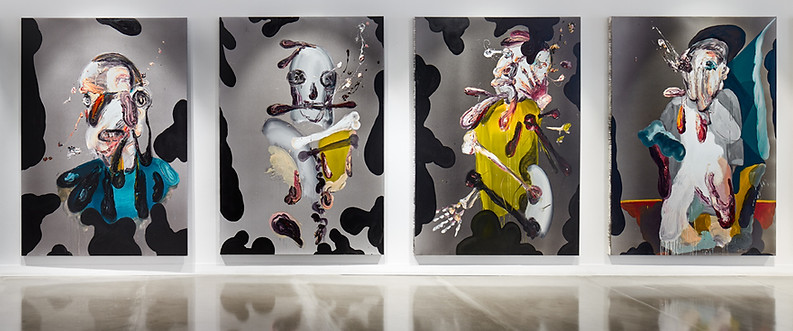
Installation view of 'Mirror of Darkness' at JD Malat Gallery
All rights reserved to JD Malat Gallery
Since his earliest work of the 1990s Erdoğan Zümrütoğlu (b. 1970) has established himself as one of Turkey’s leading emerging artists. His strikingly colourful and often large-scale canvases have already caught the eye of gallerists and collectors in both his home country as well as France and Germany, inspired as they were by his studies of paintings in Dutch and Belgian collections. The curating of an exhibition in London’s Mayfair gallery district provides an exciting opportunity for new audiences to experience the work of a painter who has always seen himself primarily as a global artist drawing on the traditions of western literature and philosophy.
Zümrütoğlu’s work to date has been inspired by those writers from both the Romantic and Modernist traditions who deal with the darker side of human existence. One of these, Heinrich von Kleist (1777-1811), like Zümrütoğlu himself, was a restless spirit, travelling to Paris and Switzerland, before finally returning to Berlin where he tragically shot himself at the age of 34, together with his terminally ill female companion. In interview, Zümrütoğlu speaks of sitting for hours at the writer’s grave in the pouring rain, getting through several packets of cigarettes, and was unable to paint for three weeks whilst he avidly read von Kleist’s writings, culminating in the three remarkable commemorative paintings Für Heinrich von Kleist (2011). As in all his work, including the current exhibition, the figure of the title is not immediately obvious to the viewer, who is amply rewarded by slow and patient exposure to the image and eventual absorption into Zümrütoğlu’s multi-layered canvas, the figure gradually emerging from the mists of the lake where the suicide took place. This is a chilling but immensely moving experience, and Zümrütoğlu’s dynamic, often violent, canvases are not for the faint-hearted. Another major influence is the French Surrealist playwright Antonin Artaud (1896-1948) whose infamous ‘Theatre of Cruelty’ utilised a strategy of involving the audience in a ‘primitive ceremonial experience’ designed to shock and reveal to us the baseness of human nature. Zümrütoğlu accomplishes this by using a similar strategy in his paintings. Like the Aristotelian cathartic moments in von Kleist’s and Artaud’s theatre, where von Kleist made deliberate linguistic errors and Artaud produced his surrealist shocks, Zümrütoğlu’s painterly process sees him absorbed in the expressionist release of his own subconscious. At interview, Zümrütoğlu speaks eloquently of himself and his artist friends discovering, often through their own experiences of literature and music, what ‘the dark truth of life is, and having the terrible burden of carrying it and communicating it to people through their art’. Zümrütoğlu refers to an ancient Greek statue of Hermes he saw as a child in an Izmir museum with which he has ever since seen a reflection of his own identity and purpose in the god who communicates divine messages to humanity.
According to Zümrütoğlu, the first reaction of the audience should be not in the eyes and brain, but ‘in the gut’, and this is certainly an essential aspect of the works in the current exhibition. Like many great artists, however, Zümrütoğlu’s paintings also have a more rational side. In his first Berlin exhibition (and first outside of Turkey), Grammar of the Other (2011), Zümrütoğlu painted the Brandenburg Gate, and created a deliberate deconstructive binary opposition by inverting the colours of the familiar ‘tourist image’ so that the positive significance of the pure white classical gate became black, reminding the viewer that historically, the gate has been a sinister barrier as well as a welcoming thoroughfare.
The title of this, Zümrütoğlu’s first UK solo show, Mirror of Darkness is a further indication of the artist’s responses to a body of Romantic and Modernist literature which deals with the binary oppositional nature of human behaviour, based as it is on Joseph Conrad’s postcolonial novel Heart of Darkness. This title also provides a poetic key as to how the viewer might approach this set of paintings, which, as it were, hold up a visual mirror to Conrad’s literary exploration of the hypocritical savage behaviour of ‘civilised’ people in a foreign country, whose Congolese natives are themselves perceived as ‘savages’. This important exhibition of recent paintings (all produced in 2018) will enable the London audience to appreciate why Zümrütoğlu has been so enthusiastically received from Turkey to Berlin. Zümrütoğlu’s interests in mythological and historical storytelling are especially evoked in his triptychs, such as Egodram (Tribute to Joseph Conrad) (2018). At nearly 5 metres wide, this painting has an immense expressive presence in the elegant white cube setting of the JD Malat gallery, and it is the dynamism of colour and highly expressive painterliness which first hits the audience - ‘in the gut’ as the artist would have it. After the initial visceral shock, the viewer becomes more gradually aware of forms emerging from the chaos: is that a white horse covered in bloody wounds in the central panel, its human rider falling with outstretched arms against a background of blue sky and white clouds, as if in an updated Guernica? From the outer panels, more human forms emerge, as if from a bomb blast, a huge foot projecting into the viewer’s space in the final panel. Moving closer, the sensually seductive and so physical brushstrokes which Zümrütoğlu is a master of, delight the eye as an organ of perception. The painting, reflecting the themes of Conrad’s novel, is a theatrical celebration of the best and worst of humanity, and, as with all these paintings, every human sense and emotion is stimulated and becomes indistinguishable, and the viewer is reminded of the artist’s own synaesthesia.
The different scales of the paintings are significant because Zümrütoğlu speaks of them as indices of his own relative emotional release during their production. Zümrütoğlu does not do preparatory drawings, preferring, like artists from Frans Hals to Francis Bacon, to develop ideas spontaneously with paint on canvas: ‘My substitute for drawing is to read books and look at the work of other artists... I have no preconceived ideas of what I am about to paint, and only discover the subject during the act of painting... if a title comes to mind whilst painting, then that becomes the painting’s title... if no title emerges, the title is ‘unknown’.’ Two other polyptychs are on display, though here the canvases are hung separately perhaps to remind us that myths/stories are episodic and sometimes fragmentary, but that the fragments work by themselves, taking on a grander meaning when reintegrated. Triple Infusion in to the Heart of Darkness (potentially a triptych) and the wittily-named Abra Cadaver (two triptychs or perhaps a single hextych!), like several other paintings in this exhibition, are series of deconstructed portraits evoking bodily disintegration into different facets of the human character (Triple Infusion) or into magically transformed skeletal remains (Abra Cadaver). These are not dissimilar in style and scale to the integrated Egodram and would appear to be equally massive outpourings of emotion. Different critics have seen different artistic influences in Zümrütoğlu’s style, who himself speaks of Baselitz and Kiefer as special interests. This author, perhaps British-biased, is reminded of the sensual markmaking of Frank Auerbach and Glenn Brown who, like Zümrütoğlu, create deconstructed portraits with similarly fluid abstract brushstrokes.
Another aspect of Zümrütoğlu’s style can be seen in Death Cantabile with its skilfully-executed renaissance perspectival floorboarding, white wall, orange ceiling and background sky creating an ordered yet giddying sense of depth in this sizable canvas. The surreal almost Daliesque human figure is completely deconstructed in a horizontal left-right direction leading to the darkness of right frame, signifying the explosive death of the subject. In the past Zümrütoğlu has often used such perspectives as well as grids to bring an oppositional sense of order to the otherwise chaotic subject: some have seen Francis Bacon as an influence here. It is natural, if regrettable, to draw comparisons with other artists when appraising the work of a fast-emerging artist such as Erdoğan Zümrütoğlu, but any visitor to Mirror of Darkness will surely agree that he is right up there with the artists and writers who have influenced him. Like a firework display, this is a magnificent spectacle with which to celebrate the start of the new London art year.